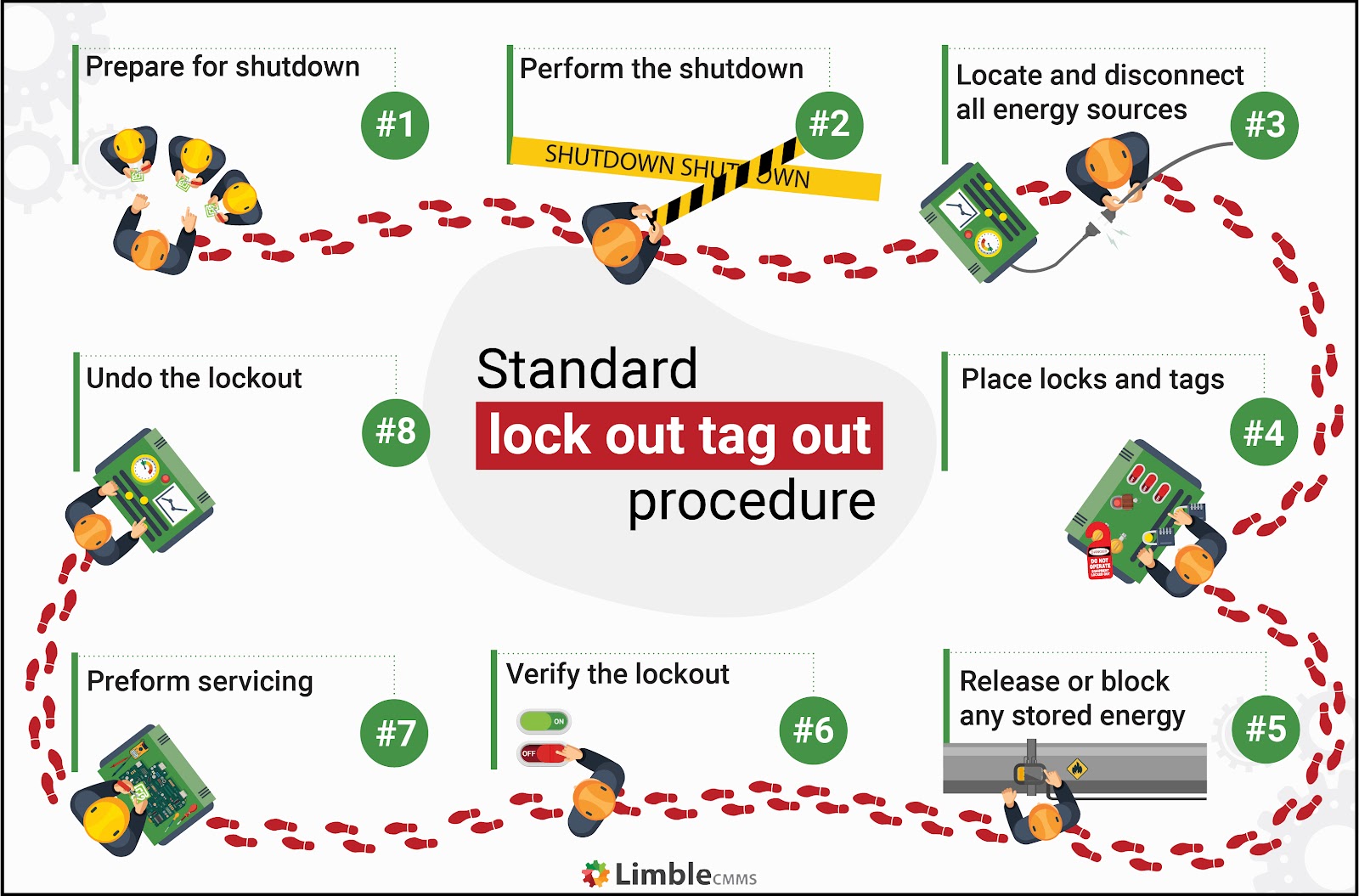
Every year, hundreds of workers suffer serious injuries—or worse—because a machine starts up unexpectedly during maintenance. The root cause? A missing or improperly executed lockout tagout (LOTO) procedure. It's not just about following rules—it's about preventing life-altering accidents. The LOTO procedure is the cornerstone of energy control in industrial environments, and misunderstanding it can cost lives.
This guide dives deep into the lockout tagout LOTO procedure—not as dry compliance text, but as a field-tested framework for real-world safety. You'll learn the exact steps, common pitfalls, and how to build a system that protects workers and holds up under OSHA scrutiny.
What Is the Lockout Tagout (LOTO) Procedure?
The lockout tagout (LOTO) procedure is a standardized safety practice used to isolate hazardous energy sources from machinery or equipment during service or maintenance. Its purpose is to ensure that equipment cannot be energized accidentally while workers are exposed to moving parts, electrical currents, pressurized systems, or other dangers.
"Lockout" refers to physically locking energy-isolating devices—like circuit breakers, valves, or disconnect switches—so they cannot be operated. "Tagout" involves placing warning tags on those devices, explaining why the lock is in place, who applied it, and when.
While often used together, lockout is more secure than tagout alone. OSHA permits tagout only when lockout isn’t feasible, and even then, additional safety measures are required.
Why LOTO Isn’t Optional
Ignoring LOTO isn’t just a paperwork issue—it’s a direct threat to worker safety. According to OSHA, failure to control hazardous energy accounts for nearly 10% of serious accidents in manufacturing. These incidents often occur during routine servicing, cleaning, or jam-clearing tasks when employees assume equipment is “off” but fail to verify isolation.
A proper LOTO procedure eliminates assumptions. It turns energy control into a repeatable, verifiable process.
The 6-Step LOTO Procedure: From Shutdown to Restart
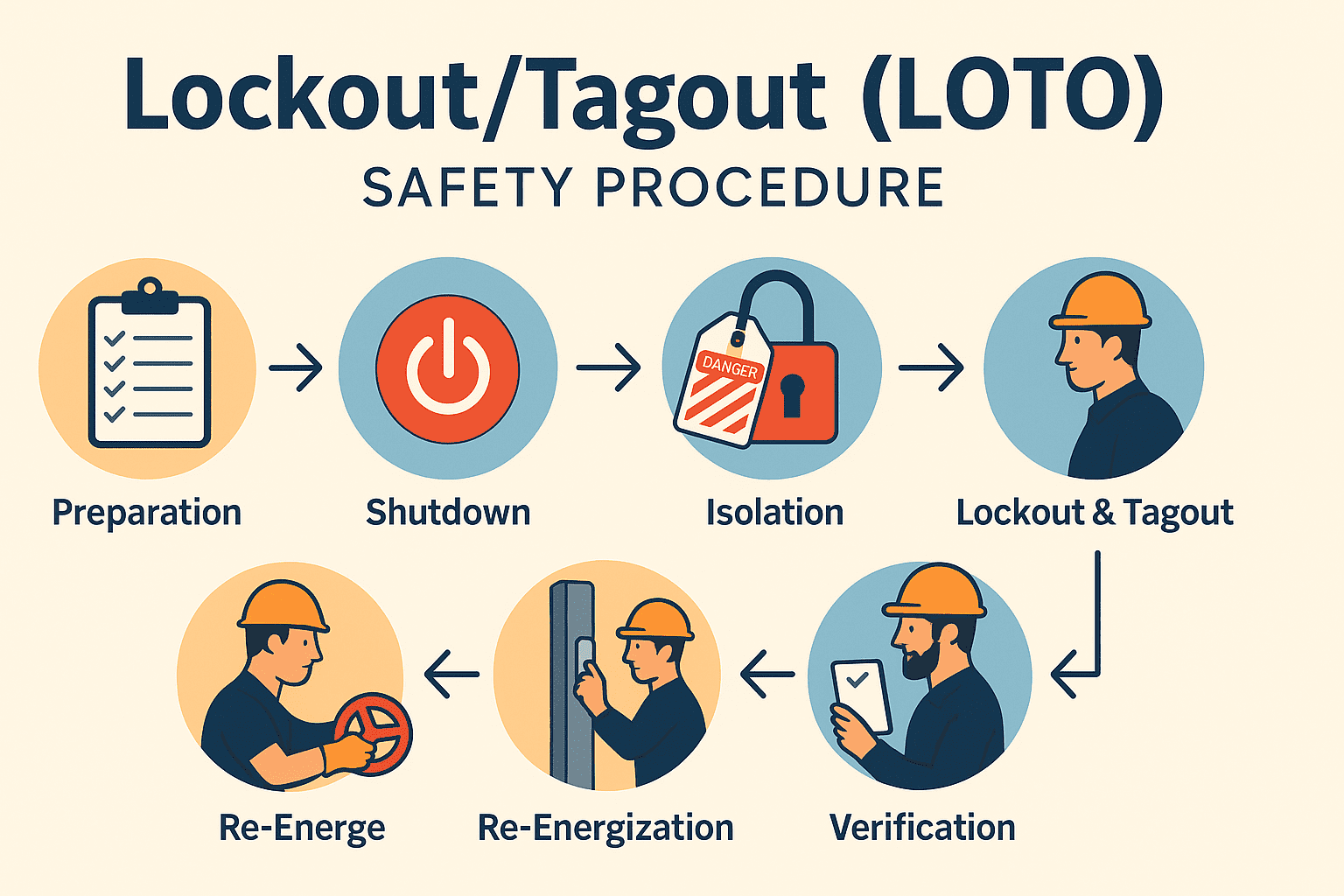
A successful LOTO procedure follows a clear, unbroken sequence. Skipping or rushing any step undermines the entire system. Here’s the standard six-phase process, with real-world context:
1. Preparation
Before any work begins, the authorized employee must identify: - The type and magnitude of energy involved (electrical, pneumatic, hydraulic, chemical, thermal, etc.) - The energy-isolating devices required - The correct locks, tags, and tools
Example: A technician preparing to service a conveyor belt must determine whether the system has electrical motors, tension springs, and gravity-fed rollers—all potential energy sources.
Common Mistake: Assuming one lock is enough. Complex machinery may have multiple disconnect points across different energy types.
2. Notification
Inform all affected employees that maintenance is about to begin and equipment will be shut down. This prevents someone from unknowingly re-energizing a system.
Best Practice: Use a verbal announcement and post a temporary notice near the equipment.
3. Equipment Shutdown
Shut down the machine using normal stopping procedures—never rely on emergency stops as the primary shutdown method.
Why it matters: Emergency stops don’t disconnect power; they only halt operation. True isolation requires cutting power at the source.
4. Isolation and Lockout
Isolate all energy sources using approved disconnects. Apply lockout devices (hasps, valve locks, circuit breaker locks) and secure them with individual locks.
Each worker performing service must apply their own lock. This is non-negotiable. Group lockout boxes are acceptable for multiple workers, but each person still uses their personal lock.
Critical Detail: Locks must be durable, standardized, and identifiable. OSHA requires locks to be: - Distinctive (e.g., bright red with clear labeling) - Solely for safety use - Key-retaining (key cannot be removed when lock is engaged)
5. Release Stored Energy
Just because power is off doesn’t mean danger is gone. Stored energy in springs, capacitors, elevated parts, or pressurized lines can still cause injury.
Procedures must include steps to: - Bleed hydraulic or pneumatic lines - Block or lower suspended components - Ground electrical circuits - Allow capacitors to discharge
Real-World Failure Case: A worker clearing a jam in a punch press was crushed when a spring-loaded ram released unexpectedly. The energy hadn’t been bled, and no blocking devices were used.
6. Verification and Restart
Before work begins, the authorized employee must verify the machine cannot start. This means attempting to start it using normal operating controls—after confirming all workers are clear.
If the machine doesn’t start and remains de-energized, the area is safe.
After work is complete: - Remove tools - Reinstall guards - Notify affected workers - Remove locks and tags - Restore energy systematically
Never restart equipment without confirming all personnel are at a safe distance.
Common LOTO Procedure Mistakes (And How to Fix Them)
Even experienced teams make errors. These are the most frequent failures—and how to prevent them:
| Mistake | Risk | Solution |
|---|---|---|
| Using a master key or shared lock | Unauthorized re-energization | Implement personal locks only |
| Skipping stored energy release | Unexpected activation | Include bleed-down steps in every LOTO plan |
| Incomplete documentation | OSHA violations | Maintain written procedures for each machine |
| Failure to train affected employees | Accidental interference | Train non-maintenance staff on LOTO awareness |
| Not verifying isolation | False sense of safety | Always test-operate after lockout |
One plant reduced LOTO incidents by 78% in 12 months simply by adding a verification checklist and requiring two-person confirmation before work began.
When Tagout Is Used Instead of Lockout
OSHA allows tagout in place of lockout only when the employer can demonstrate that tagout provides full protection. This is rare and must include: - A tag that clearly warns against operating the equipment - A procedure that ensures employee compliance - Additional safety measures (e.g., removing isolating circuit elements, blocking control switches)
Tagout is inherently less secure because tags can be ignored or removed. Relying on tagout without engineering controls is a compliance risk.
Bottom line: Use lockout wherever possible. Reserve tagout for situations where physical locking isn’t feasible—and even then, treat it as a temporary exception, not a standard practice.
Creating Machine-Specific LOTO Procedures
One-size-fits-all doesn’t work. Each piece of equipment requires its own written LOTO procedure. Here’s what to include:
- Equipment name and location
- Energy sources present
- Shutdown and isolation steps
- Type and location of lockout devices
- Stored energy release methods
- Verification process
- List of authorized employees
Example Procedure Snippet – Hydraulic Press:
- Notify production supervisor and affected workers.
- Press “Stop” button, then rotate disconnect switch to “Off.”
- Lock disconnect switch with personal lock.
- Open pressure release valve on hydraulic line; confirm gauge reads 0 PSI.
- Lower press ram fully and insert safety blocks.
- Attempt to activate press via control panel—no movement should occur.
- Begin maintenance.
- After completion, remove tools and blocks, unlock device, restore power.
Store these procedures near the equipment or in an accessible digital system. Update them after any machine modification.
LOTO Compliance: OSHA Requirements You Can’t Ignore
OSHA’s LOTO standard (29 CFR 1910.147) sets the legal baseline. Key requirements include:
- Written energy control procedures
- Periodic inspections (at least annually)
- Employee training for both authorized and affected workers
- Use of durable, standardized locks and tags
- Prohibition of outside contractors working on equipment without LOTO
Inspection Tip: During annual audits, watch for: - Missing or damaged tags - Locks left on after shift changes - Improper lock storage - Incomplete procedure documentation
A 2023 OSHA report found that LOTO violations ranked in the top 10 most cited standards, with penalties averaging $15,000 per instance. Compliance isn’t just ethical—it’s financial.
Tools and Equipment for Effective LOTO
The right tools make LOTO reliable and consistent. Here are five essential categories:
| Tool | Purpose | Example Use Case |
|---|---|---|
| Hasp Lockouts | Allows multiple locks on one isolation point | Maintenance team servicing a shared motor |
| Valve Lockouts | Prevents valve operation in pneumatic/hydraulic systems | Locking a steam line before boiler repair |
| Circuit Breaker Locks | Secures electrical disconnects | Preventing re-energizing of a production line |
| Group Lockout Boxes | Coordinates multiple workers on one job | Crew replacing a large pump system |
| LOTO Stations | Centralized storage for locks, tags, and procedures | Shop floor with multiple high-risk machines |
Invest in high-quality, standardized kits. Mixing brands or styles increases confusion and risk.
Building a Culture of LOTO Accountability
Procedures mean nothing without enforcement and awareness. Here’s how to embed LOTO into your safety culture:
- Train regularly: Conduct refresher courses every 12 months and after incidents.
- Empower workers: Let any employee stop work if LOTO isn’t followed.
- Lead by example: Supervisors must follow LOTO exactly—no exceptions.
- Audit visibly: Perform random LOTO checks and share results.
- Recognize compliance: Reward teams that maintain perfect LOTO records.
One manufacturing site introduced “LOTO Champions”—employees trained to audit and coach peers. Within a year, compliance rose from 64% to 98%.
The lockout tagout LOTO procedure isn’t a box to check—it’s a lifeline. Whether you’re maintaining a conveyor, repairing a press, or cleaning a mixer, the steps are the same: prepare, isolate, verify, and protect. Make LOTO part of your team’s muscle memory. Document every procedure, train every worker, and never assume safety. Because when the power comes back on, the only thing that should start up is the machine—not an accident.
FAQ
What is the difference between lockout and tagout? Lockout uses physical devices to prevent energy isolation, while tagout relies on warning tags. Lockout is stronger and preferred; tagout is only permitted when lockout isn’t feasible.
Who is responsible for applying LOTO devices? Authorized employees—those trained to service equipment—must apply their own locks and tags. No one else should remove them.
Can multiple people work on the same machine under LOTO? Yes, but each worker must apply their own lock. Use a group lockout box if multiple isolation points are involved.
What happens if a worker forgets to remove their lock? The lock should only be removed under a formal "lost key" procedure, typically requiring supervisor verification and documented approval.
Is LOTO required for routine production tasks? Not if the task is minor, repetitive, and takes place during normal operations—provided alternative protective measures (like guarding) are in place.
Do LOTO procedures apply to corded electric tools? Yes, if the tool is being serviced. Unplugging and locking the outlet or using a plug lockout device satisfies LOTO.
Can LOTO be digital or electronic? Traditional LOTO requires physical locks. However, some advanced electronic systems—when they meet OSHA’s performance criteria—may be used in specific settings.
FAQ
What should you look for in Lockout Tagout LOTO Procedure: A Complete Safety Guide? Focus on relevance, practical value, and how well the solution matches real user intent.
Is Lockout Tagout LOTO Procedure: A Complete Safety Guide suitable for beginners? That depends on the workflow, but a clear step-by-step approach usually makes it easier to start.
How do you compare options around Lockout Tagout LOTO Procedure: A Complete Safety Guide? Compare features, trust signals, limitations, pricing, and ease of implementation.
What mistakes should you avoid? Avoid generic choices, weak validation, and decisions based only on marketing claims.
What is the next best step? Shortlist the most relevant options, validate them quickly, and refine from real-world results.